Posts

Showing posts with the label NASA

NASA's X-59: Paving the Way for Quieter Supersonic Flight

Image
For decades, the piercing sonic boom has kept commercial supersonic aircraft from traveling over land. NASA's revolutionary X-59 QueSST (Quiet SuperSonic Technology) aircraft aims to change that. This experimental plane is meticulously designed to break the sound barrier with a gentle 'thump' rather than an ear-splitting boom, potentially opening the door to a new era of faster-than-sound air travel. The Need for Quieter Flight Since the Concorde's retirement in 2003, commercial supersonic flight has been largely absent. The primary reason lies in the sonic boom – a shockwave created when an aircraft travels faster than the speed of sound. Traditional supersonic aircraft generate booms that are disruptive and can even cause damage on the ground, leading to restrictions on supersonic travel over land. The X-59 Solution The X-59's unique design is the key to its quiet flight. Its elongated nose, carefully sculpted fuselage, and specially positioned wings w...

JWST's New Image of Saturn Is a Stunning Deep Dive into the Gas Giant

Image
The James Webb Space Telescope (JWST) has released its first image of Saturn, and it is simply stunning. The image, taken in the near-infrared spectrum, shows the planet in unprecedented detail, revealing its delicate rings and cloud bands in all their glory. The image was taken using JWST's Near-Infrared Camera (NIRCam), which is one of the telescope's four main instruments. NIRCam is designed to image objects in the near-infrared spectrum, which allows it to see through dust and gas that would otherwise obscure our view of objects in the visible spectrum. This makes it ideal for studying objects like Saturn, which are surrounded by thick atmospheres and rings. In the new image, Saturn's rings appear as a delicate filigree of light, surrounding the planet's bright yellow disk. The rings are made up of billions of small ice particles, which are held in orbit around the planet by its gravity. The particles in the rings range in size from dust grains to small ...

James Webb Space Telescope Detects Carbon Molecules in Early Universe

Image
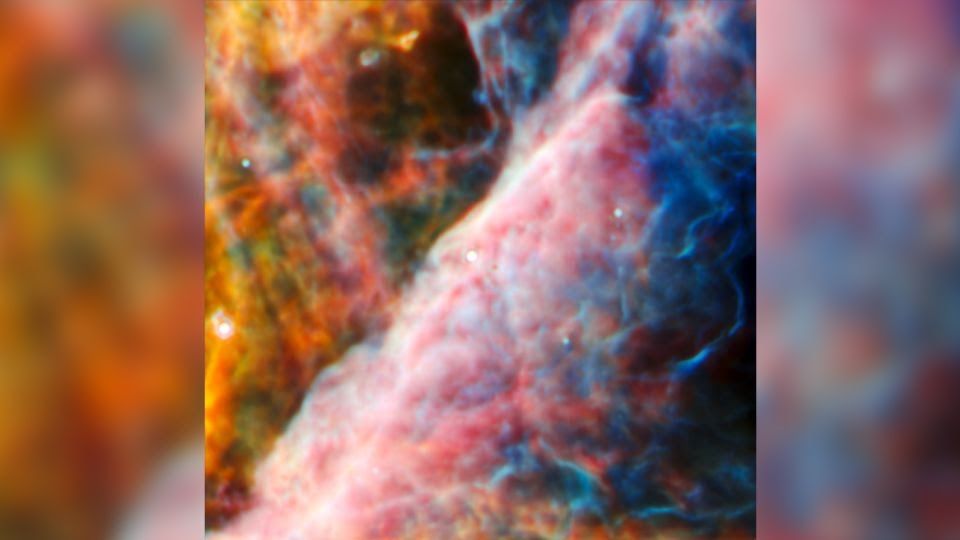
The James Webb Space Telescope Reveals the Orion Bar in Stunning Detail A team of astronomers using the James Webb Space Telescope (JWST) has detected carbon molecules in a galaxy that is 13.4 billion light-years away. This means that the molecules were present just 300 million years after the Big Bang. The molecules, called polycyclic aromatic hydrocarbons (PAHs), are a type of organic molecule that is thought to be a precursor to life. They are made up of carbon atoms that are bonded together in rings. The discovery of PAHs in the early universe is a significant finding. It provides new evidence that the building blocks of life may have been present very early on in the history of the universe. This could mean that life could have arisen more easily than previously thought. The PAHs were detected by the JWST's Mid-Infrared Instrument (MIRI). MIRI is designed to detect infrared light, which is invisible to the human eye. Infrared light can penetrate dust and gas, which...

LEGO Models Bring NASA's Mars Exploration to Life in Living Rooms

Image
Credit: NASA/JPL-Caltech/MSSS Children and adults alike can now bring the excitement of NASA's Mars exploration to their living rooms with new LEGO Technic models of the Perseverance rover and Ingenuity helicopter. The models were developed in cooperation with NASA's Jet Propulsion Laboratory (JPL) in Southern California and are based on the real vehicles, which have been roaming through Mars' Jezero Crater since landing there in February 2021. The Perseverance rover model is a detailed replica of the real vehicle, complete with working wheels, a robotic arm, and a mast with a solar panel. The Ingenuity helicopter model is also highly detailed, with a rotating rotor and a camera that can be positioned to look in different directions. Both models are challenging but rewarding builds, and they are sure to provide hours of fun for anyone who loves space exploration. In addition to the physical models, LEGO also released a digital version of the Persever...

NASA's Webb Telescope Reveals How Galaxies Transformed the Early Universe

Image
A new study using data from NASA's James Webb Space Telescope (JWST) has revealed how galaxies transformed the early universe. The study, published in the journal Nature, found that galaxies played a key role in reionizing the universe, a process that turned the once-opaque universe transparent. The study was led by Daichi Kashino of Nagoya University in Japan. Kashino and his colleagues used JWST to study a region of space that is about 13 billion light-years away. This region of space is filled with galaxies that were formed just a few hundred million years after the Big Bang. The researchers found that the galaxies in this region of space are surrounded by large bubbles of transparent gas. These bubbles are caused by the galaxies' ultraviolet radiation, which ionizes the hydrogen gas in the surrounding space. Ionized hydrogen gas is transparent to light, so the bubbles of ionized gas allow light to pass through them, making the universe appear transparent. The re...

California Residents Can Breathe a Sigh of Relief, as Water Supply Improves

Image
Credit: NASA’s Scientific Visualization Studio California's water supply has received a significant boost after a record-breaking winter. Two NASA satellites, the Gravity Recovery and Climate Experiment Follow-On (GRACE-FO) and the Gravity Recovery and Climate Experiment (GRACE), have been tracking the state's water levels, and they have found that the snowpack is at its highest level in over a decade. The GRACE-FO satellites measure changes in Earth's gravity field, which can be used to track changes in water mass. The satellites have found that California's snowpack has increased by 150% since the start of the winter. This is the largest increase in snowpack since GRACE began monitoring California in 2002. The increased snowpack is good news for California, which has been in a drought for the past several years. The state's water supply is used for drinking water, irrigation, and hydroelectric power. The increased snowpack will help to replenish the st...

Psyche Mission to Provide New Insights into Formation of Solar System

Image
NASA’s Psyche mission is set to launch in October 2023, and it will be the first mission to explore a metal-rich asteroid. The asteroid, named Psyche, is located in the main asteroid belt between Mars and Jupiter. It is about 140 miles (226 kilometers) in diameter, and it is thought to be the exposed nickel-iron core of an early planet. Credit: NASA The Psyche mission will use a solar-electric propulsion system to travel to the asteroid. The spacecraft will also carry a variety of scientific instruments, including a multispectral imager, a gamma-ray and neutron spectrometer, a magnetometer, and a gravity science instrument. The mission’s primary goal is to study the composition and structure of Psyche. Scientists hope to learn more about the formation of the solar system and the early history of planets. They also hope to learn more about the composition of Earth’s core. The Psyche mission is a high-risk, high-reward mission. If successful, it will provide valuable insights into the fo...

NASA Invites Public to Sign Poem That Will Fly Aboard Europa Clipper

Image
NASA is inviting the public to sign their names to a poem that will fly aboard the Europa Clipper spacecraft. The poem, written by U.S. Poet Laureate Ada Limón, is titled “In Praise of Mystery: A Poem for Europa.” The poem will be etched onto a microchip and placed on the spacecraft, which is scheduled to launch in October 2024. Europa is a moon of Jupiter that is thought to have a vast ocean of liquid water beneath its icy surface. Scientists believe that this ocean could potentially harbor life, making Europa one of the most important targets for future exploration. The Europa Clipper mission will conduct 34 flybys of Europa, during which it will use its instruments to study the moon’s surface, atmosphere, and ocean. The mission is expected to launch in October 2024 and arrive at Jupiter in 2027. The “Message in a Bottle” campaign is a way for the public to participate in the Europa Clipper mission and to show their support for space exploration. To sign the poem, visit t...

Aerospike Engine Could Revolutionize Spaceflight

Image
After decades of development, the aerospike engine is finally nearing its commercial debut. This revolutionary new type of rocket engine could revolutionize spaceflight by making it more efficient, affordable, and accessible. Aerospike engines work differently than traditional rocket engines. Instead of having a bell-shaped nozzle, aerospike engines have a spike-shaped nozzle that extends into the atmosphere. This allows the engine to adapt to changes in atmospheric pressure, which can improve efficiency and reduce thrust loss. Aerospike engines have several advantages over traditional rocket engines. They are more efficient at high altitudes, which is where most of the fuel is burned during a rocket launch. They are also lighter and simpler to manufacture, which can reduce costs. In addition, aerospike engines can be throttled more smoothly than traditional rocket engines, which makes them ideal for reusable launch vehicles. This is because reusable launch vehicles need to be able to ...