Posts

Showing posts with the label James Webb Space Telescope

JWST's New Image of Saturn Is a Stunning Deep Dive into the Gas Giant

Image
The James Webb Space Telescope (JWST) has released its first image of Saturn, and it is simply stunning. The image, taken in the near-infrared spectrum, shows the planet in unprecedented detail, revealing its delicate rings and cloud bands in all their glory. The image was taken using JWST's Near-Infrared Camera (NIRCam), which is one of the telescope's four main instruments. NIRCam is designed to image objects in the near-infrared spectrum, which allows it to see through dust and gas that would otherwise obscure our view of objects in the visible spectrum. This makes it ideal for studying objects like Saturn, which are surrounded by thick atmospheres and rings. In the new image, Saturn's rings appear as a delicate filigree of light, surrounding the planet's bright yellow disk. The rings are made up of billions of small ice particles, which are held in orbit around the planet by its gravity. The particles in the rings range in size from dust grains to small ...
James Webb Space Telescope Detects Carbon Molecules in Early Universe

Image
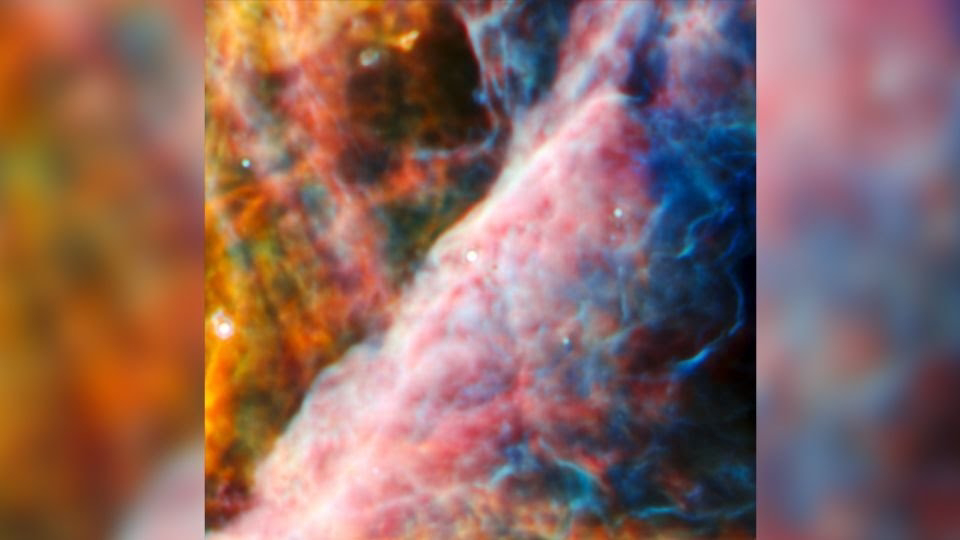
The James Webb Space Telescope Reveals the Orion Bar in Stunning Detail A team of astronomers using the James Webb Space Telescope (JWST) has detected carbon molecules in a galaxy that is 13.4 billion light-years away. This means that the molecules were present just 300 million years after the Big Bang. The molecules, called polycyclic aromatic hydrocarbons (PAHs), are a type of organic molecule that is thought to be a precursor to life. They are made up of carbon atoms that are bonded together in rings. The discovery of PAHs in the early universe is a significant finding. It provides new evidence that the building blocks of life may have been present very early on in the history of the universe. This could mean that life could have arisen more easily than previously thought. The PAHs were detected by the JWST's Mid-Infrared Instrument (MIRI). MIRI is designed to detect infrared light, which is invisible to the human eye. Infrared light can penetrate dust and gas, which...

NASA's Webb Telescope Reveals How Galaxies Transformed the Early Universe

Image
A new study using data from NASA's James Webb Space Telescope (JWST) has revealed how galaxies transformed the early universe. The study, published in the journal Nature, found that galaxies played a key role in reionizing the universe, a process that turned the once-opaque universe transparent. The study was led by Daichi Kashino of Nagoya University in Japan. Kashino and his colleagues used JWST to study a region of space that is about 13 billion light-years away. This region of space is filled with galaxies that were formed just a few hundred million years after the Big Bang. The researchers found that the galaxies in this region of space are surrounded by large bubbles of transparent gas. These bubbles are caused by the galaxies' ultraviolet radiation, which ionizes the hydrogen gas in the surrounding space. Ionized hydrogen gas is transparent to light, so the bubbles of ionized gas allow light to pass through them, making the universe appear transparent. The re...